Auto Parts Warehouse Racking: 7 Questions to Answer Before Requesting a Quote
Published:
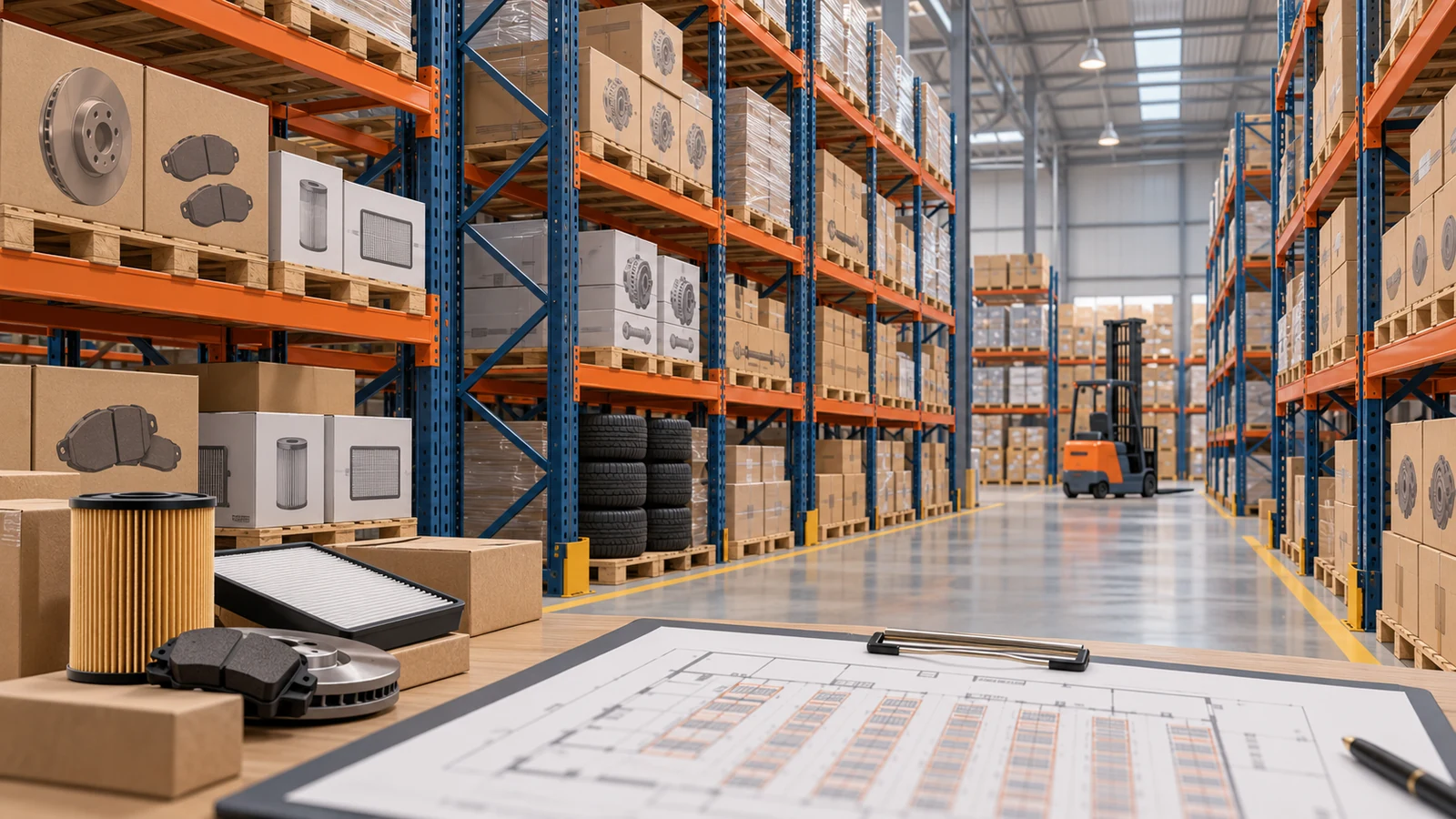
Before requesting a racking quote for an auto parts warehouse, map how parts will move from receiving to storage, picking and dispatch.
Auto parts storage is rarely simple. One warehouse may hold oil filters, brake parts, cartons of fast-moving replacement items, bulky body panels and slow-moving stock at the same time. Some products stay on pallets. Some are picked by carton. Some are picked one by one.
Before you ask a supplier for a price, work through these seven questions.
1. How many different SKUs will the warehouse handle?
A warehouse with a small number of palletized products needs a different storage approach from an aftermarket parts warehouse with hundreds or thousands of SKUs.
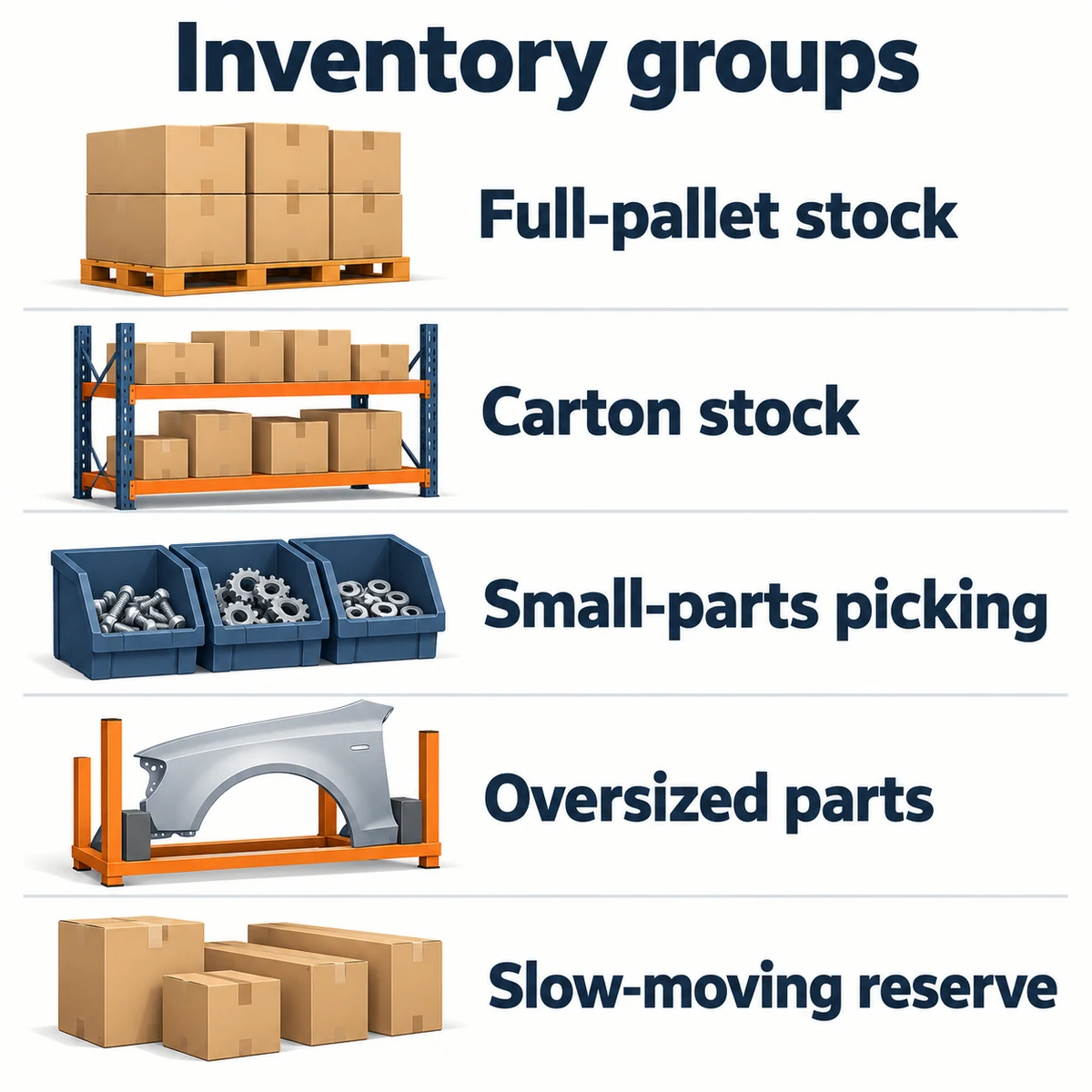
A practical way to begin is to split inventory into groups:
- full-pallet stock
- carton stock replenished by pallet
- small parts picked individually
- oversized or awkward parts
- slow-moving reserve stock
This helps you see whether you are really planning one storage system, or several storage zones inside the same warehouse.
In many auto parts operations, pallet racking is only one part of the answer.
2. What are the real pallet sizes and loaded weights?
Do not just write down “standard pallet.” Record the actual information:
- pallet length and width
- loaded height
- maximum loaded weight, including the pallet
- whether loads overhang the pallet
- whether the weight is evenly distributed
A loaded pallet’s weight is an input to the proposal, not a rack capacity rating. As RMI explains, frame capacity depends on beam spacing and the loads placed on the beams.
If weights are estimates, mark them as unconfirmed so they can be checked before the configuration is finalized.
3. Which products need fast access, and which do not?
Some stock moves every day. Some only moves once in a while. Some items may need direct pallet access, while others can be stored more densely.
That is why it helps to separate inventory by movement:
- fast-moving stock
- medium-turnover stock
- slow-moving reserve stock
If direct access to each pallet position is important, that usually points the discussion toward selective pallet racking. If storage density matters more than immediate access, other layouts may also be worth evaluating.
Agree the access requirement before choosing a storage system.
4. Will the warehouse ship full pallets, cartons or individual parts?
In some auto parts warehouses, full pallets are received and shipped with very little handling in between. In others, pallets are only used for reserve storage, while day-to-day orders are picked by carton or by piece.
Ask yourself:
- Are pallets shipped out directly?
- Are cartons picked from pallet stock?
- Are individual items picked at a separate location?
- Will reserve stock feed a forward picking area?
If the operation includes both reserve storage and picking, the warehouse may need more than one working zone.
Plan the replenishment route as well as the storage positions.
Reserve storage vs. picking area
For a distributor selling filters or brake pads by the box, a full pallet may be a replenishment unit rather than a customer order. Describe both jobs in the RFQ.
| Planning point | Reserve storage | Picking area |
|---|---|---|
| Stored unit | Complete pallets of incoming or backup stock | Open cartons, bins or individual parts used to build orders |
| Access | Forklift access for pallet put-away and retrieval | Access to the required SKUs for carton or piece picking |
| Space to allow | Pallet positions, lift height and truck manoeuvring | Pick locations, access to cartons or bins, and space for picking containers |
| Quote input | Pallet dimensions, maximum loaded weight and reserve quantity | Carton or bin sizes and weights, pick-face quantity and replenishment method |
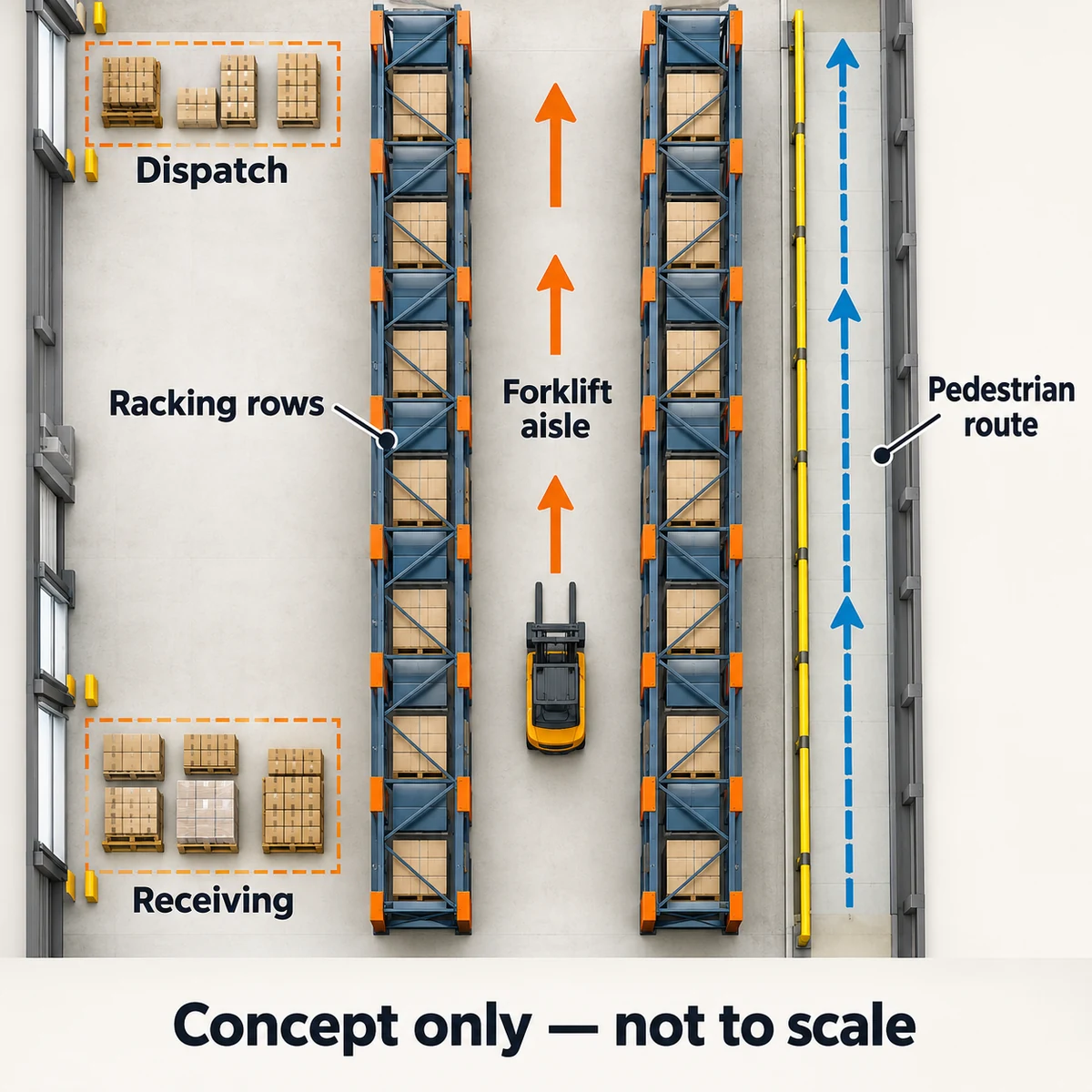
Separate the reserve quantity from the stock needed at each pick face. Identify how pallets will be opened and transferred to picking locations without bringing pickers into an active forklift route.
5. What equipment will operate between the racks?
Aisle width should not be guessed.
Before discussing layout, confirm what handling equipment will actually be used:
- forklift make, model and any attachments
- manufacturer’s aisle requirement for the intended load
- pallet orientation and load dimensions during handling
- lift height
- access and traffic routes
Check the truck manufacturer’s aisle requirement for the actual load and its orientation; turning radius alone is not the aisle width.
Also look at the warehouse itself:
- columns
- wall clearances
- doors
- dispatch and receiving areas
- pedestrian routes
- blocked or protected areas
Plan replenishment so that forklift work and pedestrian picking are separated where possible. OSHA’s pedestrian-traffic guidance describes this principle in the U.S. context.
6. Is the warehouse likely to change in the next few years?
A business may add new product lines, increase SKU count or change its picking method as it grows. A warehouse that works well today may become difficult to run if the storage profile changes.
You do not need to predict everything. But it helps to answer questions like:
- Will SKU variety increase?
- Will order profiles become smaller and more frequent?
- Will more space be needed for picking?
- Is reserve pallet storage likely to grow?
These answers help the supplier understand whether the priority is immediate density, operational flexibility or a balance between the two.
7. What should be included in the RFQ?
You do not need a finished engineering package to start a conversation.
A useful RFQ gives the supplier enough information to discuss a configuration and define the quotation scope.
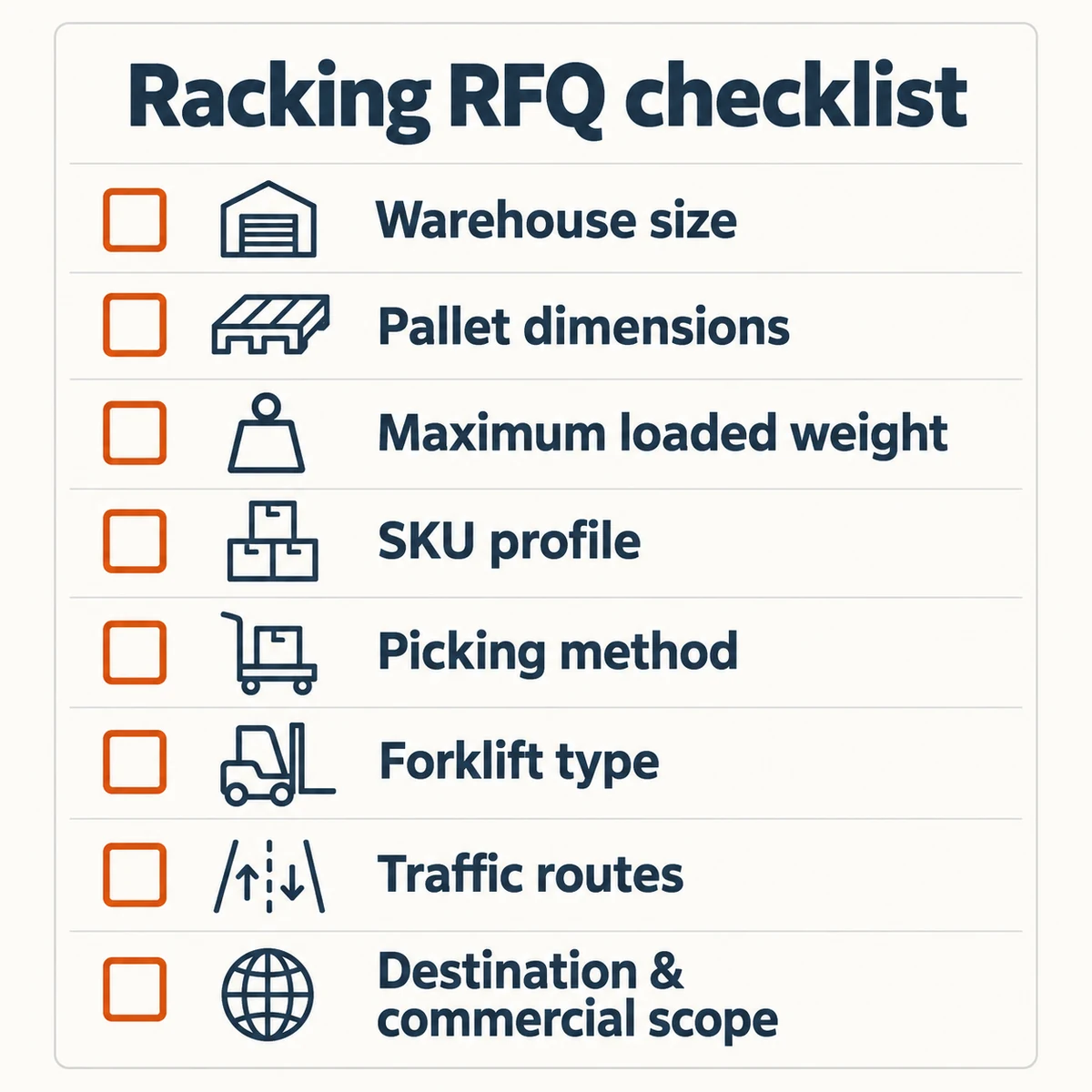
Here is a practical checklist:
| Item | What to provide |
|---|---|
| Warehouse size | Length, width, clear height and key obstructions |
| Product profile | Main part categories and approximate SKU mix |
| Pallet data | Dimensions, loaded heights and maximum weights |
| Storage target | Approximate pallet positions or storage requirement |
| Order method | Full-pallet, carton picking or piece picking |
| Equipment | Forklift type and handling constraints |
| Traffic | Receiving, dispatch and main movement routes |
| Commercial scope | Destination country, expected quantity and required documents |
If some details are still unknown, mark them clearly. That is better than filling the RFQ with guesses.
A simple example
Imagine an auto parts distributor storing oil filters, brake pads, packaged engine parts and some bulk cartons.
At first glance, the buyer may think the requirement is simply “pallet racking for the warehouse.”
But after a short review, the operation may actually include:
- reserve pallet storage for incoming stock
- a carton-picking area for fast-moving items
- a separate area for slower and mixed inventory
- forklift routes that must stay clear during replenishment
Send a brief the supplier can quote against
Send HAO RACKING a warehouse sketch with dimensions and clear height, pallet dimensions and maximum loaded weights, the main SKU groups, and whether orders leave by pallet, carton or piece. Include the forklift make and model, intended lifting height and any attachments.
If reserve storage feeds a picking area, show the quantities and handling method for each. Mark unknown information as “to be confirmed”; there is no need to turn estimates into fixed requirements.
Discuss your racking requirements, or use our Warehouse Racking RFQ Checklist to organize the brief.
This article is a planning guide. Final configuration, engineering scope, load verification and local compliance requirements should always be confirmed for the actual project.