Cantilever Racking for Steel Pipes and Profiles
Steel pipes, hollow sections and H-beams need a purchasing brief that describes the load and the handling method. A material name or maximum bundle weight alone does not define a suitable cantilever rack. Start by grouping the goods that will share a storage run.
Build a material and bundle schedule
| Record for each material group | Information to send | Question it resolves |
|---|---|---|
| Lengths | Shortest, longest and most frequently stocked lengths | Which goods will share a run and which support arrangement needs review? |
| Bundle dimensions | Width, height, packing method and any loose pieces | What occupies the arm and how will pieces be restrained? |
| Maximum stored weight | Weight per bundle and the bundles intended at each storage level | What load distribution must the supplier review? |
| Material form | Round pipes, tubes, sections, H-beams or mixed profiles | Are rolling, irregular shape or separation requirements present? |
| Stock access | Whole-bundle or individual-piece picking, replenishment and dispatch | Which goods need direct access? |
| Handling | Full truck model, attachments or crane arrangement, with a sketch | Can the proposed rack and aisle arrangement be handled as intended? |
Keep support spacing separate from overall material length
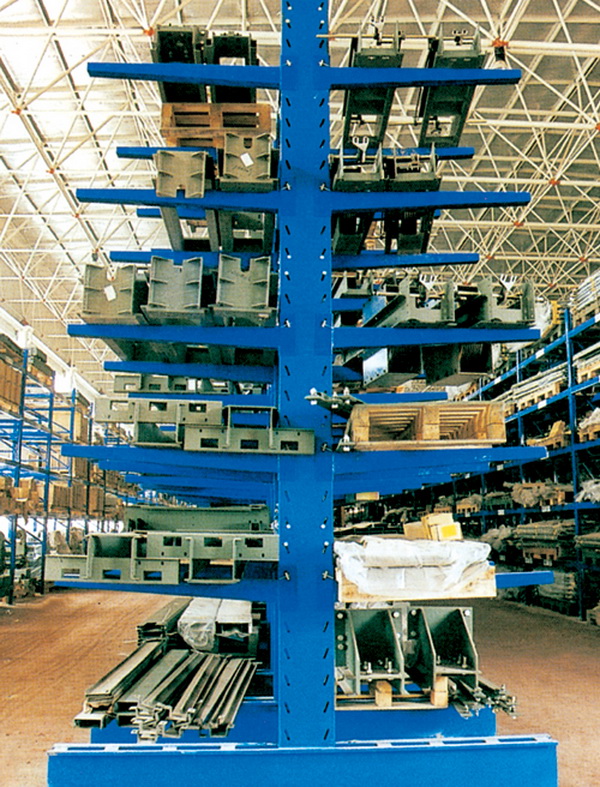
Give the supplier a proposed loading sketch showing where each bundle is supported and how far it projects beyond the end supports. A long load may span several arms; its load is not automatically shared equally between them. The responsible designer needs the material behavior, contact points and intended loading conditions before confirming arm spacing and rated configuration.
Do not divide a bundle weight by the number of visible arms and treat the answer as an approved arm capacity. Likewise, matching an arm length to a bundle width does not establish stability or the safe handling arrangement.
Compare a single-sided and double-sided purchase
A single-sided run provides access from one face; a double-sided run needs an operating plan for both faces. Mark walls, columns, available floor area and the goods-loading direction. Compare the base and column arrangement, arm quantities, bracing and specified stops together. A two-sided order is not defined simply by doubling the arms in a one-sided quotation.
Example of a clear steel-stock inquiry
Illustrative brief: “We store mixed lengths of bundled steel pipe and H-sections. Attached is a line-by-line schedule of lengths, bundle dimensions and maximum weights, with photographs of the packing. Please review a new independent cantilever arrangement against our handling sketch. Identify the proposed support points, loading assumptions, component quantities and any information still needed.”
Record which material groups are included in the review and which remain open. Separate a supplier’s concept drawing from project-specific engineering, floor checks and local approvals.
Prepare the component quotation
Ask for columns, bases, arms, bracing, fixings and any specified stops or other accessories to be itemized against one drawing revision. Confirm finish, package identification and unloading requirements. Our cantilever racking specifications set out steel material, 50 / 100 mm adjustment options and 300 / 500 / 1000 kg per-arm quotation loads; the quotation comparison guide helps align scope.
Download the RFQ worksheet or send your material schedule for a quotation review. Final support spacing, capacities and available supply require confirmation for the actual arrangement.