
Cantilever Racking for Timber and Lumber Storage
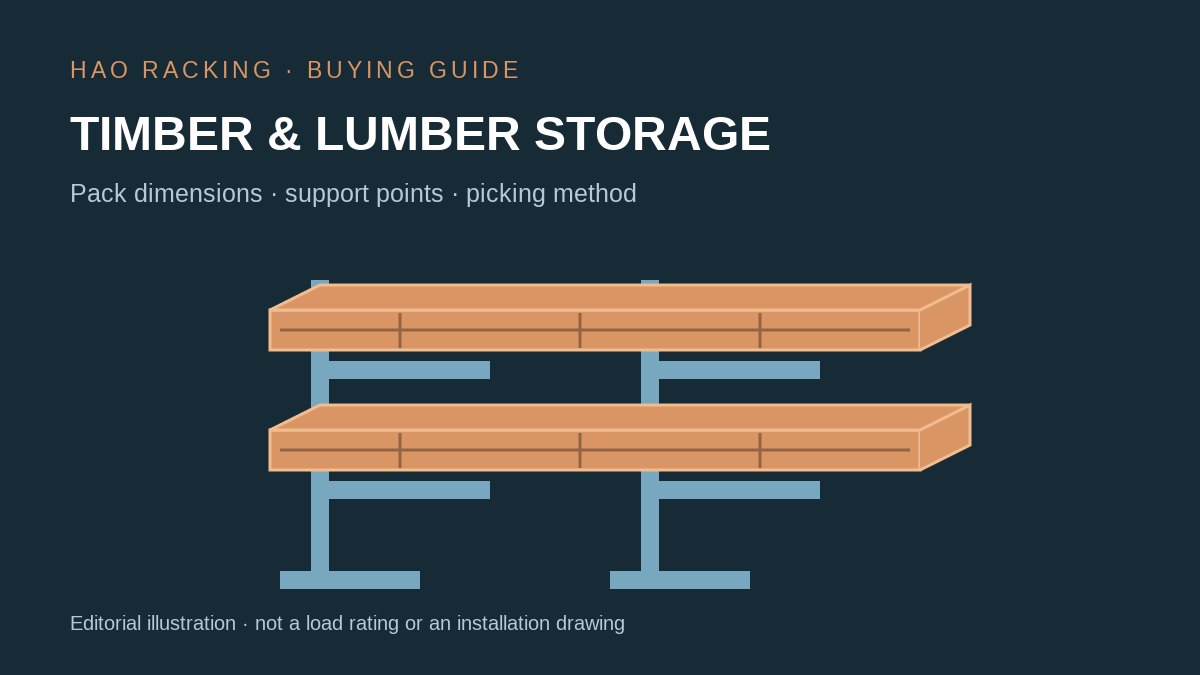
Timber merchants and warehouse equipment distributors can use cantilever racking to discuss storage for suitable long goods. The useful starting point is a schedule of the timber packs, lengths, weights and picking method. Confirm the actual support and handling arrangement before selecting rack dimensions.
Separate long timber packs from sheet materials
A pack of long timber, loose boards and a stack of sheet materials can have different support and retrieval needs. Describe each group separately. Do not assume that an arrangement proposed for a rigid bundled load also suits loose, flexible or sheet goods.
| Timber storage group | Record in the inquiry | Clarification before ordering |
|---|---|---|
| Full timber packs | Length range, pack width and height, maximum weight, straps and bearers | Support points, pack orientation and whole-pack handling |
| Mixed lengths | Shortest and longest packs expected in each storage zone | Whether shorter goods obtain the required support |
| Loose boards or partial packs | Picking frequency, remaining pack stability and manual access | Suitable storage arrangement and restraint review |
| Sheet or panel products | Panel dimensions, pack weight and retrieval method | Whether a different support surface or storage system is needed |
| Outdoor or covered storage | Site exposure, ground/floor details, roof or canopy proposals | Environmental, finish and structural scope for the actual site |
Explain how stock is picked
State whether the customer retrieves a complete pack by forklift or selects smaller quantities from a partly used pack. Include the handling equipment’s full model, attachments and access direction, together with the warehouse sketch. Mark customer picking areas and routes that must remain clear.
Rack quantity and nominal space are only part of the purchase. A layout also needs a workable process for incoming packs, temporary staging, replenishment and dispatch. Leave aisle dimensions provisional until the truck and actual load arrangement have been checked.
Confirm support and load assumptions
Provide the actual pack support and bearer positions where known. Ask the responsible supplier or designer to confirm the required support spacing, arm arrangement and rated configuration for the intended timber. Neither an illustrative photograph nor the word “heavy duty” establishes that a particular timber pack is suitable.
Record the proposed stored weight per pack and per level with clear units. Identify goods that may change after the initial order. A later change in pack length, weight or storage arrangement needs review before being treated as part of the original rating.
Keep finish and accessories in the supply list
For each run, confirm single- or double-sided access, columns, bases, arms, bracing, fixings and specified end stops or other accessories. State the storage environment and ask which finish is proposed. A canopy, cladding or building connection requires its own confirmed design and scope; it is not an automatic inclusion in a rack quotation.
Send a timber-stock purchasing brief
Use one line for each timber or panel group, retain the drawing revision and list unknown items. Review our cantilever materials, arm-load options and component requirements, then complete the RFQ worksheet. For mixed warehouses, use long span shelving to discuss suitable hand-picked cartons or parts separately.
Request a quotation review with your pack schedule, site sketch, intended handling method and delivery destination.